Foundation Watering and Slab Leaks: What Denton's 2024 Stage 2 Taught Homeowners
In August 2024, a filter failure at the Lake Lewisville treatment plant pushed Denton into Stage 2 of its drought plan, and foundation watering was restricted for weeks. For a lot of homeowners, that was the first time anyone told them their foundation needed watering at all. This guide explains why it matters for the pipes under your house.
The short answer
Denton sits on expansive clay. When it dries, it shrinks and pulls away from a slab foundation. When it gets wet again, it swells. A foundation that dries unevenly moves unevenly, and water and drain lines cast into or under that slab take the stress.
Watering the soil around a foundation during dry spells keeps the moisture more even, which limits that movement. It is not a cure for slab leaks, but it removes one of the main things that causes them.
The rest of this guide covers what happened in 2024, how clay actually damages pipe, how to water a foundation without wasting water, and what to do if you suspect a leak already.
What happened in Denton in 2024
The trouble started with equipment, not rain. According to the City of Denton, two damaged filters at the Lake Lewisville treatment plant reduced how much water the city could treat. The city asked residents to conserve, then entered Stage 2 of its Drought Contingency Plan on August 20, 2024, after demand topped treatment capacity for three straight days.
Stage 2 cut outdoor irrigation to once a week. The city's notices also listed limits on pool fills, drip irrigation and foundation watering. The restrictions stayed in place until October 8, 2024, when the filter repairs were finished and normal watering schedules returned.
That stretch lined up with late summer, when North Texas clay is already at its driest. For homes that relied on sprinklers to keep beds and lawns near the foundation damp, the soil lost more moisture than usual.
The practical lesson is not that the city got it wrong. Water treatment capacity is finite, and the rules protected the supply. The lesson is that your foundation's moisture should not depend entirely on a lawn sprinkler schedule the city can change.
How clay movement cracks pipes
Expansive clay can change volume a surprising amount between wet and dry. The Blackland Prairie soils that run through Denton County are some of the most active in Texas.
A slab rests on that soil. When one side dries and drops while another side stays damp, the slab flexes. Supply lines cast into the concrete, often copper in older homes and PEX in newer ones, are locked in place. They cannot slide with the movement, so stress concentrates at bends, fittings and spots where the pipe touches concrete.
Over months and years, that stress opens pinholes and cracks fittings. Drain lines under the slab can separate at joints or sag into low spots. None of this happens overnight, which is why slab leaks often show up a season after a drought rather than during it.
How to water a foundation the right way
The goal is steady, even moisture, not soaking. Always follow the city's current watering schedule, which may treat foundation watering differently from lawn irrigation.
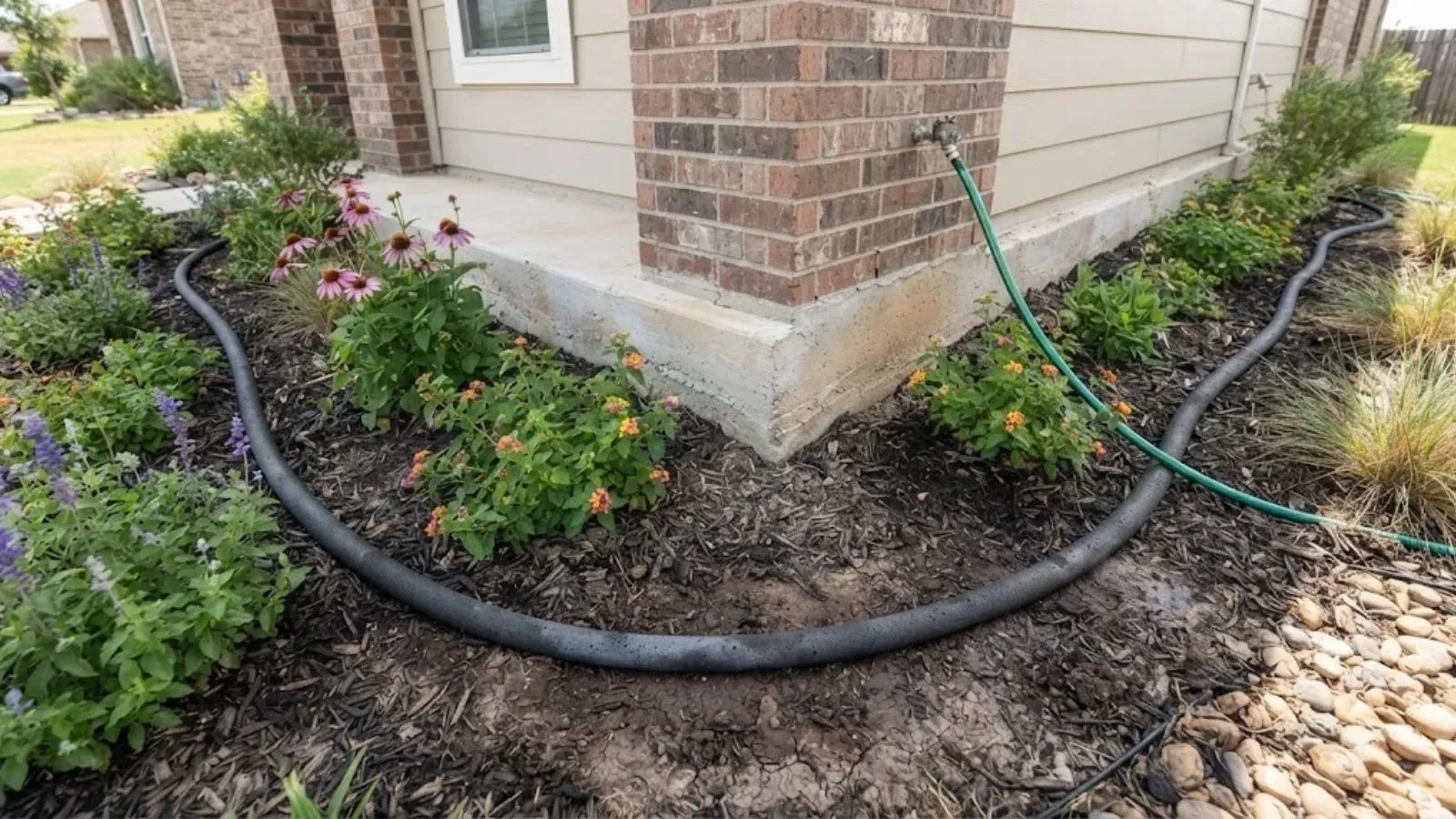
- Water the soil 12 to 18 inches out from the foundation, not right against the slab. Water pooling at the edge can run under the house.
- Use a soaker hose or drip line laid in a loop around the house, so the whole perimeter gets similar moisture.
- Water in the early morning or evening, when less is lost to evaporation.
- Water less, more often, during long dry spells, rather than a single heavy soak after weeks of nothing.
- Check that gutters and downspouts carry roof water away from the foundation. Too much water in one spot causes movement too.
- Watch the gap. If you see soil pulling away from the slab edge, that side needs more attention.
Check the City of Denton's current drought stage before you water. Rules change with conditions, and stage restrictions can limit how and when foundation watering is allowed.
Signs your slab has moved, and what they mean for plumbing
Some foundation movement is cosmetic. Some points to stress on the pipes below. Here is how to read the signs.
| What you see | What it may mean | Plumbing step |
|---|---|---|
| New diagonal cracks at door or window corners. | The slab has shifted. | Run a meter test for hidden leaks. |
| Doors that stick or will not latch. | Frame movement from slab settling. | Watch the water bill for the next month. |
| Cracked floor tile in a line. | Slab flexing beneath. | Check for warm spots on hot-water runs. |
| Soil gap along the foundation edge. | The clay is drying and shrinking. | Start even foundation watering. |
| Damp carpet or a hissing sound. | A possible active leak. | Call for leak detection now. |
If you think a leak has already started
The meter test is the fastest check. Turn off every fixture, the ice maker and the irrigation controller, then look at the leak indicator on your water meter. If it keeps turning, water is leaving the system somewhere.
Close the house shutoff and look again. If the indicator stops, the leak is inside the house. If it keeps moving, it is likely in the yard line between the meter and the house.
From there, a plumber isolates the hot and cold sides, traces the lines and uses acoustic or thermal tools to find the exact spot. Our leak detection service explains those steps. If the leak turns out to be under the slab, the options are covered on the slab leak repair page.
One more point: a leak under a slab adds water to the soil in one spot. That can make the clay swell unevenly, which moves the slab further. Fixing the leak comes before any foundation repair, or the repair will not hold.
Homes in newer suburbs are not immune
It is easy to assume only older houses have this problem. In practice, newer subdivisions on the edges of Denton and in nearby towns sit on the same clay. Fresh fill around a new slab can settle during its first few dry summers, which is when some of the first leaks in a new house appear.
Homes around Corinth and other suburbs south of Denton are a good example. Most are slab-on-grade houses on the same soil profile, and the same watering habits apply.
Foundation watering questions
It does not guarantee anything, but it reduces the uneven soil movement that stresses pipes under the slab. Think of it as lowering the odds, not eliminating them.
There is no single number, because soil, shade and slope vary. The aim is soil that stays about as moist near the foundation as it is a few feet out. If the soil pulls away from the slab, it is too dry.
Yes. Constant soaking, or water pooling against the slab, can make the clay swell unevenly and send water under the house. Even and moderate is the goal.
Policies differ. Many pay to access a sudden leak but exclude damage from settling or earth movement. Read your policy, and ask your agent before you need to file.
Denton Apex Plumbing coverage map
Coverage map for Denton and the nearby Denton County towns we serve.
Need a plumber for this?
Call the 24/7 line for Denton and nearby towns. Describe what you are seeing.
Call (940) 229-7314