Leak Detection in Denton, TX
A water meter that keeps turning, a damp baseboard or a bill that jumped for no reason. Our leak detection service in Denton, TX pinpoints where the water is going before anyone opens a wall, a floor or the yard, and the 24/7 line is open if water is actively spreading.
My bill went up but I cannot see any water. Now what?
Leak detection is the process of confirming a leak exists, narrowing it to one line and then pinpointing the spot to within a few feet. Most people do not call asking for it by name. They call because something does not add up.
In Denton the usual starting point is a City of Denton water bill that climbed while habits stayed the same. Others hear water running with every tap closed, find a damp baseboard behind the washer or watch a ceiling stain spread below a bathroom.
Each of those symptoms points somewhere different. The culprit might be a buried yard line, a pinhole inside a wall, a line under the foundation or a fixture that is quietly running. Finding which one it is comes before any quote for a fix.
A two-minute meter test you can do first
This tells you whether the leak is real and roughly where it is. It costs nothing.
- Turn off every faucet, the ice maker, the irrigation controller and anything else that uses water.
- Find the water meter in its box near the street and lift the lid. Look for the small triangle or dial marked as the leak indicator.
- If the indicator is spinning, water is leaving the system somewhere.
- Close the house shutoff valve, often in the garage on slab homes, and check the meter again.
- If it stops, the leak is inside the house. If it keeps moving, the leak is likely in the yard line between the meter and the house.
Before calling, also put a few drops of food coloring in each toilet tank. Color showing in the bowl after 15 minutes means a leaking flapper, which is the cheapest leak there is.
The tools used to pinpoint a hidden leak
Good leak detection narrows the search in stages, from the whole house to one line to one spot. Each tool answers a different question.
Pressure and isolation testing. The hot side, the cold side and the yard line are isolated and pressure-tested one at a time with a gauge. A line that loses pressure is the one leaking, which rules out the rest of the house in minutes.
Acoustic listening. Water escaping a pressurized pipe makes a hiss that ground microphones and contact sensors can pick up through concrete, drywall or soil. The plumber walks the line and marks where the sound peaks.
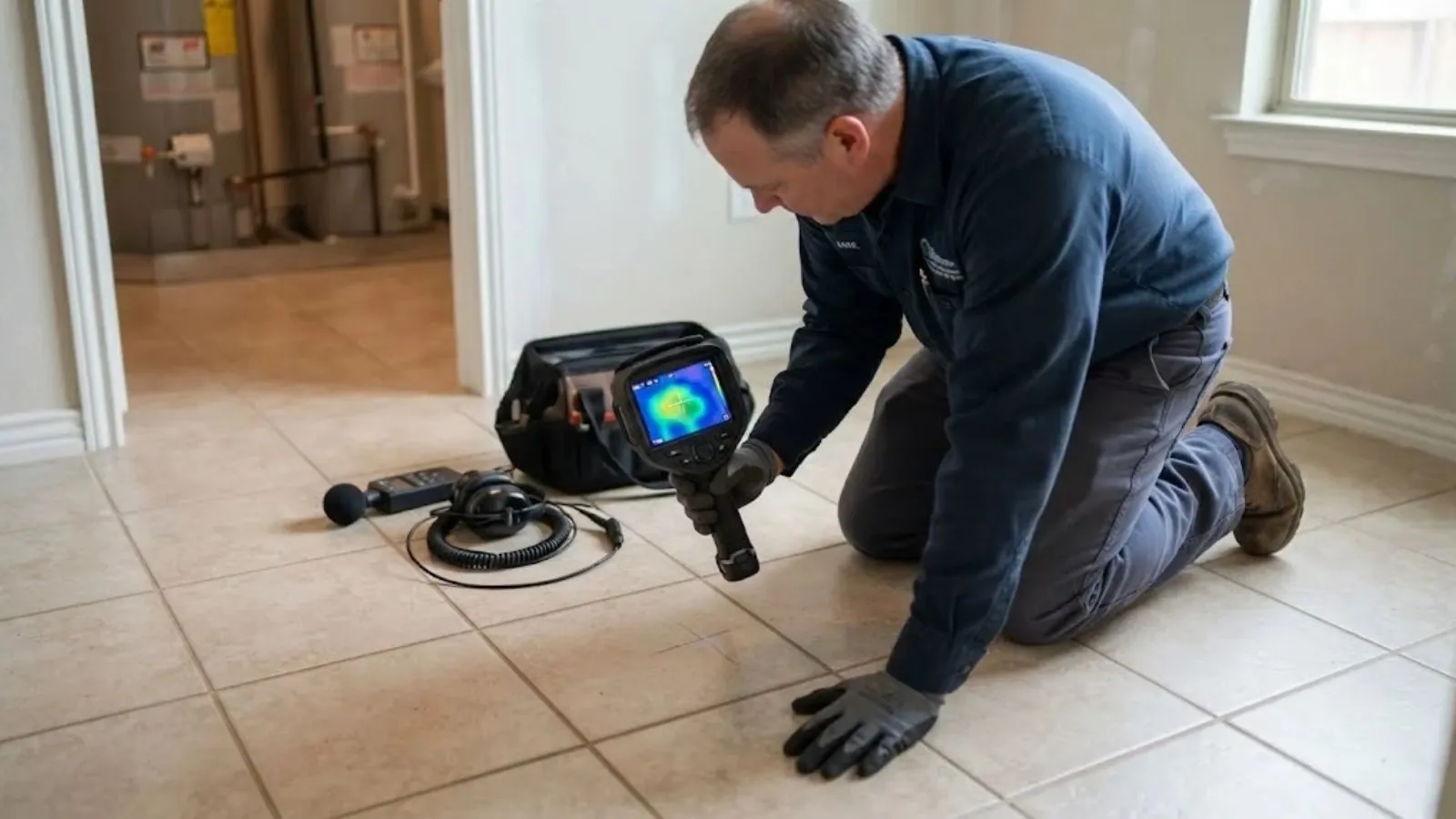
Thermal imaging. A hot-water leak warms the surface above it. An infrared camera shows that warm spot on a floor or wall, which helps confirm a slab leak on the hot side.
Moisture meters and line tracing. Meters measure dampness behind drywall and baseboards. A line locator traces where a buried pipe actually runs, since older plans are often wrong.
What each symptom usually means in a Denton home
This is where the search usually starts. Local soil and housing age shift the odds.
| Symptom | Most likely source | What gets tested first |
|---|---|---|
| Meter spins with the house valve closed. | The yard line from the meter to the house. | Line tracing and acoustic listening along the yard. |
| Meter stops when the house valve closes. | A leak inside the house or a running toilet. | Toilet dye test, then isolation testing. |
| Warm spot on a slab floor. | A hot-water line under the slab. | Thermal imaging and a hot-side pressure test. |
| Stain on a ceiling under a bathroom. | A shower valve, drain or supply line above. | Moisture mapping and a fixture-by-fixture check. |
| Water pooling in the yard after dry weather. | A cracked service line or irrigation line. | Irrigation zone test, then the service line. |
If testing confirms the leak is under the foundation, the next step is covered on our slab leak detection and repair page.
Leaks a meter test can miss
Not every high bill comes from a broken pipe. Some water losses are intermittent, so the meter looks still at the moment you check it.
Toilets that run now and then. A worn flapper can leak for a few seconds every half hour, refilling the tank with a quiet hiss. The dye test catches it.
A water softener stuck in regeneration. A failed control valve can send water down the drain for hours. Listen near the softener, or check whether its drain line is running.
Irrigation zones. A cracked head or a valve that will not fully close only leaks while the system is pressurized. Running each zone and watching for pooling finds it.
A failing pressure reducing valve. If house pressure creeps too high, the water heater relief valve may discharge now and then. A gauge on a hose bib shows the true pressure.
Once a repair is made, the 2021 International Plumbing Code (IPC) that Denton enforces expects new or repaired supply piping to hold pressure under test before it is covered. A good plumber retests the line before closing anything up.
Why Denton clay makes buried leaks more common
Much of Denton sits on expansive clay at the edge of the Blackland Prairie. It swells when wet and shrinks during dry spells, and every cycle pulls on buried pipe and the joints between sections.
The summer of 2024 showed how fast the ground can change. The city spent August 20 to October 8 under Stage 2 watering limits after two filters failed at the Lake Lewisville treatment plant, including limits on foundation watering. Dry clay around a house can shrink away from the slab, and shifting is what cracks lines.
The practical takeaway is simple. If your meter test fails after a long dry spell or a sudden soaking rain, the yard line and the slab lines deserve a close look before the interior fixtures.
Leak checks before you buy a Denton home
A standard home inspection looks at visible plumbing. It rarely tests for hidden leaks under a slab or in the yard line, and those are exactly the leaks Denton's clay soil tends to produce.
Before closing on an older home, ask the seller for permission to run a simple meter test with every fixture off. If the leak indicator moves, a leak detection visit before closing costs far less than finding the problem after you own the house.
It also helps to ask what the supply pipe is made of. Galvanized steel, polybutylene and decades-old copper under a slab all raise the odds of future leaks, and a buyer can plan or negotiate around them.
What affects the cost of leak detection
A flat price over the phone would be a guess. These factors decide how long the search takes.
- How many lines need isolating. A single-story slab home with one manifold is faster than a two-story home with several branches.
- Where the leak is. A yard line leak is often found faster than a small pinhole under tile.
- Access to the meter and shutoff valves. Buried or seized valves add time.
- Commercial or rental property. More fixtures and occupied units mean more coordination.
- Time of the call. After-hours visits usually cost more than a scheduled weekday appointment.
Many homeowner policies pay to open and close the floor or wall to reach a covered leak, even when they do not pay for the pipe repair itself. Check your policy before assuming either way.
Leak detection questions
In most cases, yes. Pressure testing, acoustic listening and thermal imaging are all non-destructive. Opening a floor or wall only happens after the spot is pinpointed, and then only enough to reach the pipe.
In most cities, including Denton, the utility owns the meter and the line on the street side of it. The line from the meter to the house is usually the owner's responsibility. If the leak is at the meter itself, call the city utility first.
A straightforward yard line or fixture leak can take an hour or two. A pinhole leak under a slab in a larger home can take longer, since each line has to be isolated and tested in turn.
Yes. Offices, retail spaces and multi-unit buildings get the same method. Details are on our page for businesses and rental properties.
Yes. Homeowners in nearby towns such as Sanger, north on I-35 can use the same number.
That is common in Denton, especially after a freeze. The irrigation zone gets isolated and repaired, and the backflow device on the system gets checked while the plumber is there.
Denton Apex Plumbing coverage map
Coverage map for Denton and the nearby Denton County towns we serve.
Something does not add up on your water bill?
Call for leak detection anywhere in Denton, TX. If water is spreading right now, the line is open 24/7.
Call (940) 229-7314