Is Your High Water Bill a Leak? How to Read Your Denton Water Meter
A high water bill that jumps with no change in habits usually has one of a handful of causes, and most of them can be narrowed down in under half an hour with nothing more than a flashlight and some food coloring. Here is how to do it in a Denton home.
Start with the obvious causes
Before assuming a hidden leak, rule out the ordinary reasons a bill goes up. Summer irrigation is the big one. A lawn watered on the city's schedule through a hot Denton July can use far more water than the house itself.
Other ordinary causes include house guests, a new pool fill, a garden project or a billing period that ran a few days longer than usual. Compare the gallons used, not just the dollar amount, against the same month last year.
If the usage is up and none of those explain it, it is time to look for water going somewhere it should not.
Step one: the meter test
This test tells you whether water is flowing when nothing should be using it.
- Turn off every faucet, shower and appliance that uses water. Turn off the ice maker, the water softener if it is regenerating, and the irrigation controller.
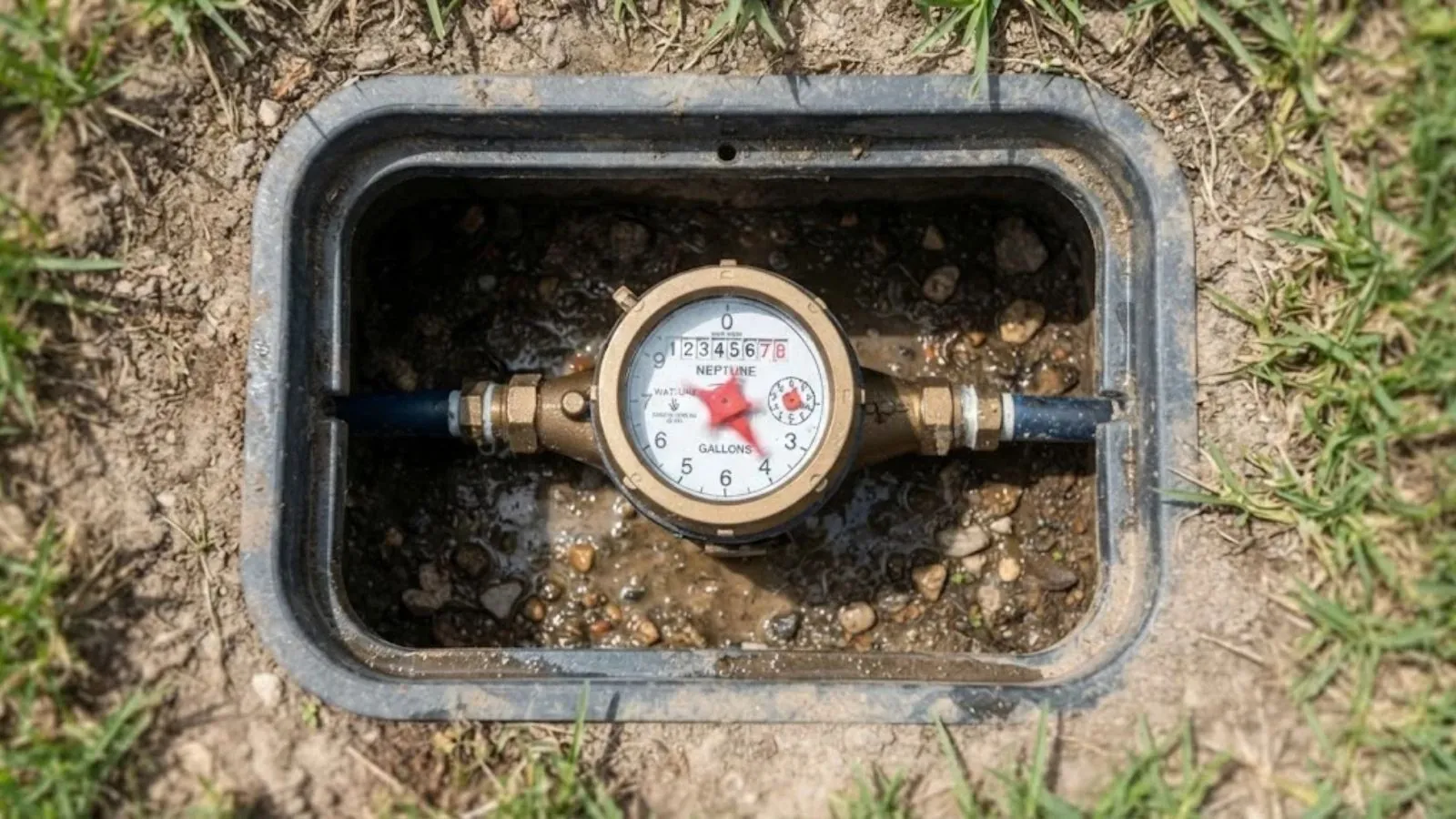
- Find your water meter. In most Denton neighborhoods it sits in a box near the street or sidewalk, with a lid you can lift.
- Look for the leak indicator. It is usually a small triangle, star or dial on the meter face that spins when any water flows.
- Watch it for two or three minutes. If it moves, water is leaving the system.
- Write down the full meter reading, wait an hour without using water, and read it again. Any change confirms a leak.
Watch for snakes, spiders and wasps when you open a meter box in summer. A flashlight and gloves help.
Step two: find out which side of the house
Close the house shutoff valve. On many Denton slab homes it is in the garage or near where the water line enters the house. Then check the meter again.
If the indicator stops, the leak is inside the house, in a fixture, a wall or under the slab. If it keeps moving, the leak is between the meter and the house, in the buried service line, or in an irrigation line that branches off before the shutoff.
This one test cuts the search in half. It also tells you who to call. A leak at the meter itself or on the street side belongs to the City of Denton. A leak on your side belongs to you.
The usual suspects inside a Denton home
If the leak is inside, these are the places to check, roughly in order of how often they turn out to be the cause.
| Suspect | How to check | What it usually costs to fix |
|---|---|---|
| Running toilet. | Food coloring in the tank, wait 15 minutes. | Low. Often a new flapper. |
| Dripping faucet or showerhead. | Look and listen at each fixture. | Low. A cartridge or washer. |
| Water softener stuck regenerating. | Listen near the unit, check its drain line. | Low to moderate. A control valve repair. |
| Water heater relief valve dripping. | Look at the discharge pipe. | Low to moderate, depending on why. |
| Leak inside a wall. | Stains, soft drywall, musty smell. | Moderate, plus drywall repair. |
| Leak under the slab. | Warm floor spots, hissing, cracked tile. | Higher. Needs pinpointing first. |
The toilet dye test, done properly
Toilets deserve their own section because they are the most common hidden leak. A worn flapper can let water trickle from the tank into the bowl for weeks. It often makes no noise, and the bowl looks normal.
Take the tank lid off and add enough food coloring to tint the water clearly. Do not flush. Wait 15 to 20 minutes. If color shows up in the bowl, the flapper is leaking.
Mineral-heavy water shortens the life of rubber flappers and fill valves, so this test is worth doing once a year even when the bill looks normal. A leaking flapper is usually one of the cheapest repairs in the house, and our toilet repair page covers the rest of the tank.
Irrigation leaks: the summer surprise
Sprinkler systems cause more high-bill calls in Denton than most people expect. A cracked head, a broken lateral line or a valve that will not fully close can leak for weeks. Some leaks only happen while the system is pressurized, so the meter test with the controller off can miss them.
Run each zone one at a time and walk it. Look for geysers, pooling, soggy spots in dry weather or heads that barely spray. Then check the valve box for water standing around the valves.
Homes with irrigation also have a backflow prevention assembly, which the City of Denton requires to be tested regularly. A damaged assembly can leak too, especially after a freeze.
When to call a plumber
Call when the meter test shows a leak and you cannot find it at a toilet, faucet or sprinkler. Call right away if you see signs of a slab leak: a warm floor, the sound of running water with everything off, or new cracks in tile.
A plumber isolates the hot, cold and yard lines one at a time, then uses acoustic and thermal tools to find the exact spot. Inside Denton city limits, the repair itself is held to the 2021 International Plumbing Code (IPC), which expects repaired supply piping to hold pressure under test. That process is laid out in how a hidden leak gets pinpointed. Finding the leak first keeps the repair small.
The same approach works across our service area, including homes on city wells and blended water in Sanger and other nearby towns.
High water bill questions
Many utilities have a leak adjustment policy for repaired leaks, often requiring proof of the repair. Contact the city's utility customer service to ask what applies and what documentation they need.
It varies a lot with how badly the flapper leaks, but a steady leak can add thousands of gallons a month. That is why the dye test is worth doing.
Yes. Meters are read on a schedule, so a leak that started mid-cycle may only show fully on the next bill. Checking the meter directly is faster than waiting.
Yes. Small leaks grow, and a leak under a slab or inside a wall does damage you cannot see. Early repairs are almost always cheaper.
Denton Apex Plumbing coverage map
Coverage map for Denton and the nearby Denton County towns we serve.
Need a plumber for this?
Call the 24/7 line for Denton and nearby towns. Describe what you are seeing.
Call (940) 229-7314