How Long Do Water Heaters Last on Denton Water?
Most water heaters do not fail on a schedule, but they do follow a pattern. On Denton's lake-sourced water, sediment and scale are the two things that most often cut a tank's life short. This guide explains how long to expect, how to read your tank's age and what actually extends it.
The typical range
A standard tank water heater commonly lasts somewhere around 8 to 12 years. Tankless units often last longer, sometimes 15 to 20 years, if they are descaled regularly. Those are general industry ranges, not promises, and local water has a lot to do with where your unit lands.
Denton's water comes from Lewisville Lake and Ray Roberts Lake. Published hardness figures for the city disagree, but mineral film on fixtures and sediment in tanks are common. That pushes many tanks here toward the shorter end of the range unless someone maintains them.
The good news is that the two main causes of early failure, sediment and a spent anode rod, are both cheap to address if you catch them early.
How to find your water heater's age
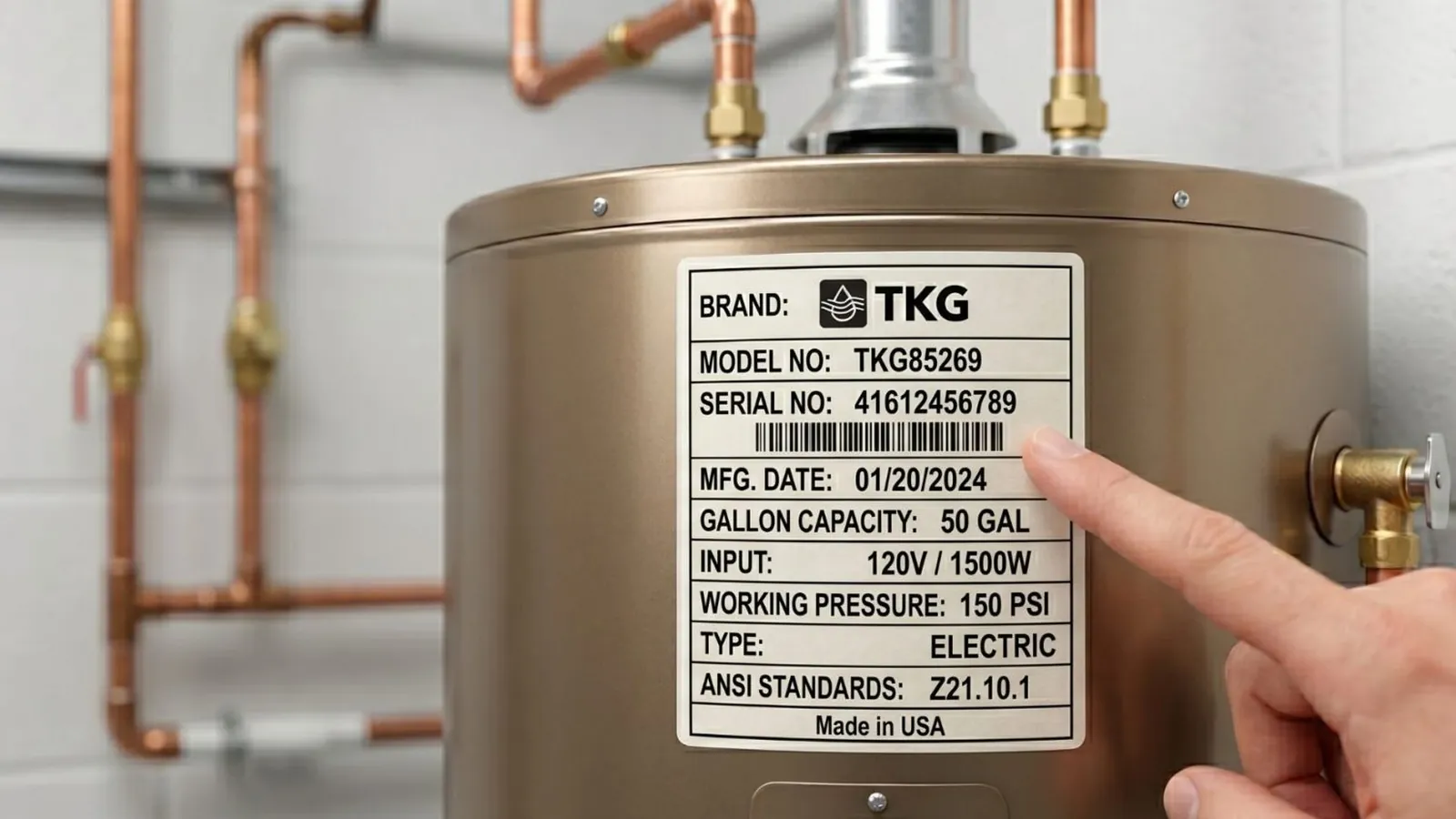
The age is printed on the tank. It just is not always obvious.
- Find the rating plate or sticker on the side of the tank.
- Look for a manufacture date. If there is none, the serial number usually encodes it.
- Many brands put the year and month in the first four characters of the serial number, often as a letter for the month and two digits for the year, or as year then week.
- If the code is unclear, search the brand name plus serial number date code, or photograph the plate and ask the plumber on your next call.
If your home was built in the 1990s or 2000s and you have never replaced the heater, it is very likely past its expected life.
What shortens a tank's life in Denton
Sediment. Minerals settle to the bottom of the tank. On a gas unit, that layer sits between the burner and the water, so the steel bottom runs hotter and weakens. On an electric unit, the lower element gets buried and burns out. The sign is popping or rumbling as the tank heats.
A spent anode rod. The anode is a metal rod that corrodes on purpose to protect the steel tank. Once it is gone, the tank itself starts to rust. Mineral-heavy water uses anodes up faster.
High water pressure. If the pressure reducing valve on the house fails, pressure stress on the tank and relief valve goes up.
Garage temperature swings. Most Denton heaters sit in garages that swing from summer heat to winter cold. Cold incoming water in January makes the unit work harder.
Maintenance that adds years
None of these are expensive. Together, they are the difference between a tank that fails early and one that reaches the end of its expected range.
| Task | How often | Why |
|---|---|---|
| Flush the tank. | Once a year. | Removes sediment before it hardens. |
| Test the relief valve. | Once a year. | Confirms the safety valve opens and reseats. |
| Inspect the anode rod. | Every 3 to 4 years. | Replace it before it is fully used up. |
| Check house water pressure. | Every couple of years. | A failing pressure valve stresses the tank. |
| Look for rust or drips. | Every few months. | Catches small leaks at fittings and valves. |
What to do before you flush a water heater yourself
A yearly flush is simple, but hot water and gas or high-voltage power are involved. These safety steps come first.
- Turn a gas unit's control knob to pilot, or switch off the breaker for an electric unit. Never run an electric tank's elements without water in it.
- Close the cold water supply valve on top of the tank.
- Let the water cool for a few hours if you can. Water at the drain valve can scald.
- Open a hot faucet in the house so air can enter the tank as it drains.
- Run the drain hose to a driveway or floor drain, not onto a lawn or into a garage where hot water can pool.
- If the drain valve is plastic and brittle, or will not close afterward, stop and call a plumber rather than forcing it.
Relief valves on older tanks sometimes drip after being tested. The 2021 International Plumbing Code (IPC) enforced in Denton requires the discharge pipe to run full size to a visible, approved spot, so a drip goes somewhere safe rather than behind a wall.
Repair or replace?
Age is the biggest factor. A tank under about eight years old with a failed thermostat, element or thermocouple is usually worth repairing. A tank over about ten years old that is leaking from the body is not repairable at all.
In between, look at the pattern. One repair on an older tank can make sense. A second or third repair on the same unit usually means the money would be better spent on a replacement. Our water heater repair page has a decision table by symptom and age.
If replacement makes sense, it is also a chance to reconsider the type. Tank, tankless and heat pump units each suit different households, and the options are covered on the water heater installation page.
Signs the end is near
Plan a replacement if you see these, rather than waiting for a failure in the garage.
- Rust-colored hot water that does not clear.
- Rust or corrosion at the base or around the fittings on top.
- Loud rumbling that returns soon after a flush.
- Water at the base that is not from a valve or fitting.
- Hot water that runs out much faster than it used to.
Towns with different water
The same rules apply around Denton, but water sources differ. Homes in Krum and other towns with groundwater in the mix, or on private wells, may see heavier sediment, especially after a well problem. A sediment filter at the main line can help protect the tank in those homes.
Water heater lifespan questions
It reduces scale, which is one of the main causes of early failure. Softened water can use up anode rods somewhat faster, so keep checking the anode.
Yes, with care. Turn off power or set gas to pilot, close the cold supply, attach a hose to the drain valve and run it outside. Hot water scalds, so let it cool first if you can.
Sediment on the tank bottom. Water trapped under it boils in small bursts. A flush often quiets it. If it returns quickly, the sediment may be hardened.
If it is over about ten years old and showing warning signs, yes. A planned replacement costs less than an emergency swap plus water damage cleanup.
Denton Apex Plumbing coverage map
Coverage map for Denton and the nearby Denton County towns we serve.
Need a plumber for this?
Call the 24/7 line for Denton and nearby towns. Describe what you are seeing.
Call (940) 229-7314