Tankless Descaling: How Often in North Texas?
Tankless water heaters are efficient and compact, but they are less forgiving of mineral scale than a tank. On North Texas water, descaling is the single most important thing an owner can do. Here is how often, how to tell it is overdue and how it is done.
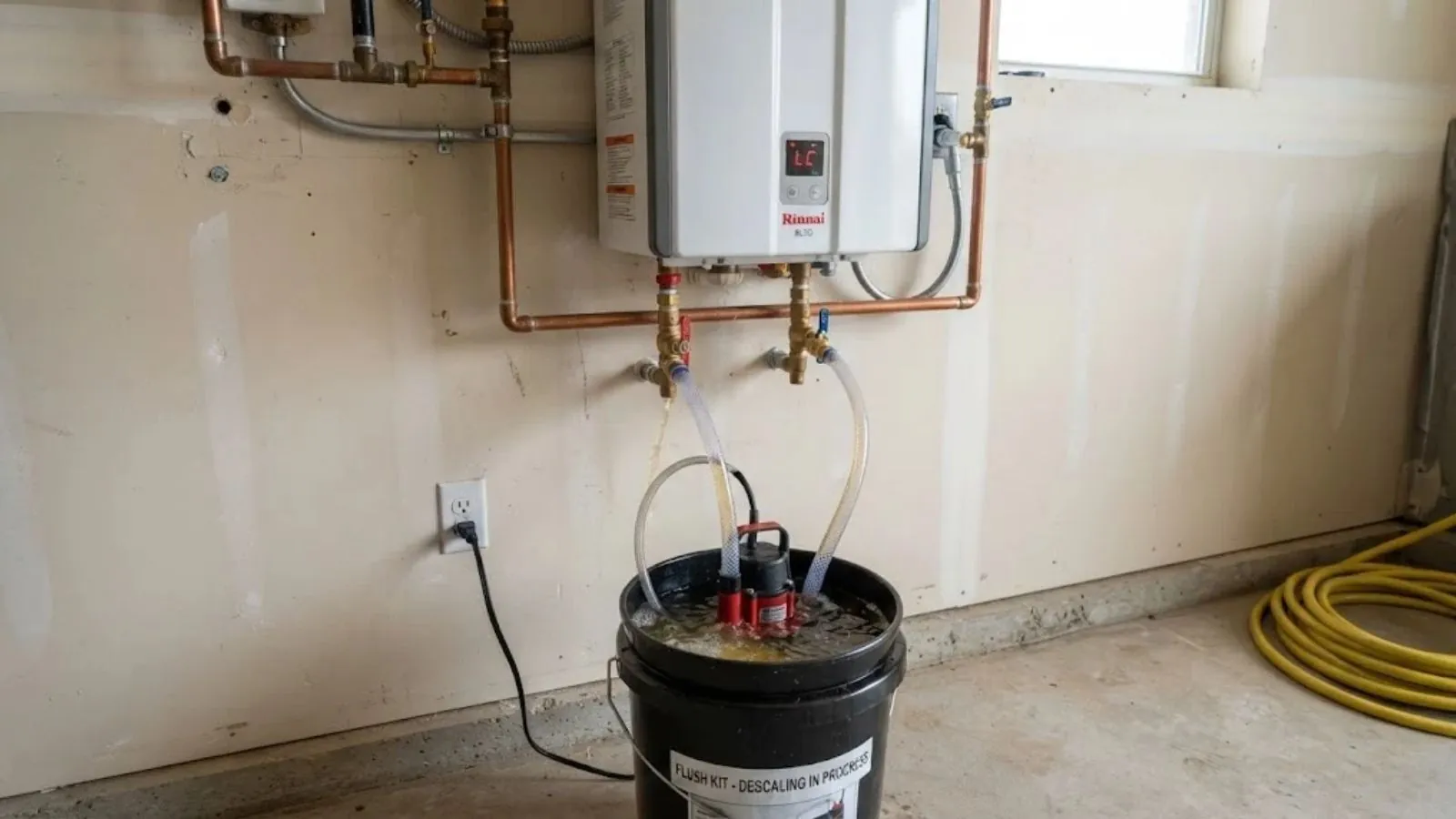
The short answer: about once a year
Many manufacturers and installers recommend descaling a tankless unit about once a year on hard or moderately hard water. Some manuals set their own interval, and it is worth checking yours, because a missed interval can affect warranty coverage.
The right interval really depends on your water and your use. A large household with several showers a day pushes more water through the heat exchanger, and more minerals with it. A single person may be able to go longer.
Denton-area water comes from a patchwork of sources. The City of Denton draws on Lewisville Lake and Ray Roberts Lake, while some nearby towns blend lake water with groundwater. That variation is one more reason to test your own tap rather than rely on a city-wide number.
Why scale matters so much in a tankless unit
A tankless heater warms water as it flows through a narrow heat exchanger. Minerals in the water drop out as scale on those hot surfaces, just like the crust on a kettle.
Scale acts as insulation. The burner or element has to work harder to heat the same water, efficiency falls, and hot spots form on the exchanger. Eventually the unit's sensors detect overheating and shut it down with an error code.
Left long enough, scale can damage the exchanger itself, which is one of the most expensive parts to replace. A yearly descaling costs a small fraction of that.
Signs your unit is overdue
Watch for these between services.
- An error code on the display, especially one related to overheating or flow.
- Water that swings between hot and lukewarm at steady flow.
- Water that is never as hot as it used to be.
- A noisier burner or fan than normal.
- Reduced hot water flow at several fixtures.
Safety steps before you start
A tankless unit combines very hot water with gas or high-amperage power. Check these before touching it.
- If you smell gas, stop. Leave the house and call Atmos Energy or 911 from outside.
- Turn off power at the breaker, not just the display. Electric units draw heavy current.
- Let the unit cool. Water in the heat exchanger can be scalding right after use.
- Do not touch the venting. A loose or damaged vent is a carbon monoxide risk and a job for a plumber.
- After a hard freeze, look first. Water dripping from the cabinet can mean a cracked internal line. Do not restart until it is checked.
How descaling is done
This is the standard process. It requires isolation valves on the unit. If yours has none, adding them is the first step. Follow your manual, and turn off power and gas before starting.
- Shut off power and gas, then close the hot and cold isolation valves.
- Connect hoses from a small submersible pump in a bucket to the service ports on the valves.
- Fill the bucket with descaling solution or plain white vinegar, as the manual allows.
- Open the service ports and circulate the solution through the heat exchanger for about 45 to 60 minutes.
- Drain the solution, then flush the unit with clean water for several minutes.
- Remove and clean the inlet water filter screen, then reinstall it.
- Close the service ports, open the isolation valves, and restore gas and power. Check for leaks and correct temperature.
If you smell gas at any point, stop, leave the house and call the gas utility from outside.
DIY or professional service?
Descaling is manageable for a handy owner. A professional visit adds checks most owners skip.
| Owner descale | Professional service | |
|---|---|---|
| Descaling. | Yes, with the right pump and valves. | Yes. |
| Inlet filter cleaning. | Yes. | Yes. |
| Burner and flame check. | Rarely. | Yes. |
| Venting and combustion check. | No. | Yes. |
| Gas pressure check. | No. | Yes. |
| Error history review. | Sometimes, via the display. | Yes. |
Reducing how often you need it
The most effective way to stretch the interval is to remove minerals before they reach the heater. A water softener sized to your tested hardness does that. Many owners who add one find scale builds far more slowly.
Setting the unit's temperature no higher than you need also helps. Scale forms faster at higher temperatures.
When a unit keeps throwing errors after a proper descale, the cause may be something else: a gas line too small for the unit's full-fire demand, a venting problem or a failing sensor. Those need a diagnosis rather than another flush. Our page on tankless repairs and descaling covers that work, and the water softener installation page explains how sizing works.
A note for homes on well water
Homes on private wells, or on supplies that blend well water, can carry more minerals and more sediment than lake water. Around Argyle and other towns where wells are part of the supply, a sediment filter ahead of the tankless unit, plus a softener, often makes the biggest difference.
Keeping a service record
Write down the date of every descaling, the product used and anything unusual, such as an error code or a long cleanup cycle. A strip of tape on the inside of the unit's cover or a note on your phone is enough.
That record does three jobs. It tells you when the next service is due. It shows a plumber how quickly scale builds in your home, which helps decide whether a softener makes sense. And it supports a warranty claim, since many manufacturers ask for proof of regular maintenance before covering a heat exchanger.
Installation and gas piping for these units follow the 2021 International Plumbing Code (IPC) and its companion fuel gas code inside Denton, which is why a permit and inspection are usually part of a new install.
Tankless descaling questions
Many manufacturers allow white vinegar. Some specify their own solution. Check the manual, since using the wrong product could affect warranty coverage.
A plumber can add them. It is a one-time job that makes every future descaling much simpler.
No. It fixes scale-related overheating. Ignition, flame, venting and gas supply errors need their own diagnosis.
Usually about an hour, longer if the unit has not been serviced in years and needs a second descaling cycle.
Denton Apex Plumbing coverage map
Coverage map for Denton and the nearby Denton County towns we serve.
Need a plumber for this?
Call the 24/7 line for Denton and nearby towns. Describe what you are seeing.
Call (940) 229-7314