Water Softener Installation & Repair in Denton, TX
White crust on faucets, spotty dishes and a water heater that rumbles. A softener can help, but only if it is sized to the water you actually have. Water softener installation and repair in Denton, TX starts with a test, not a sales pitch.
Start with a test, not a guess
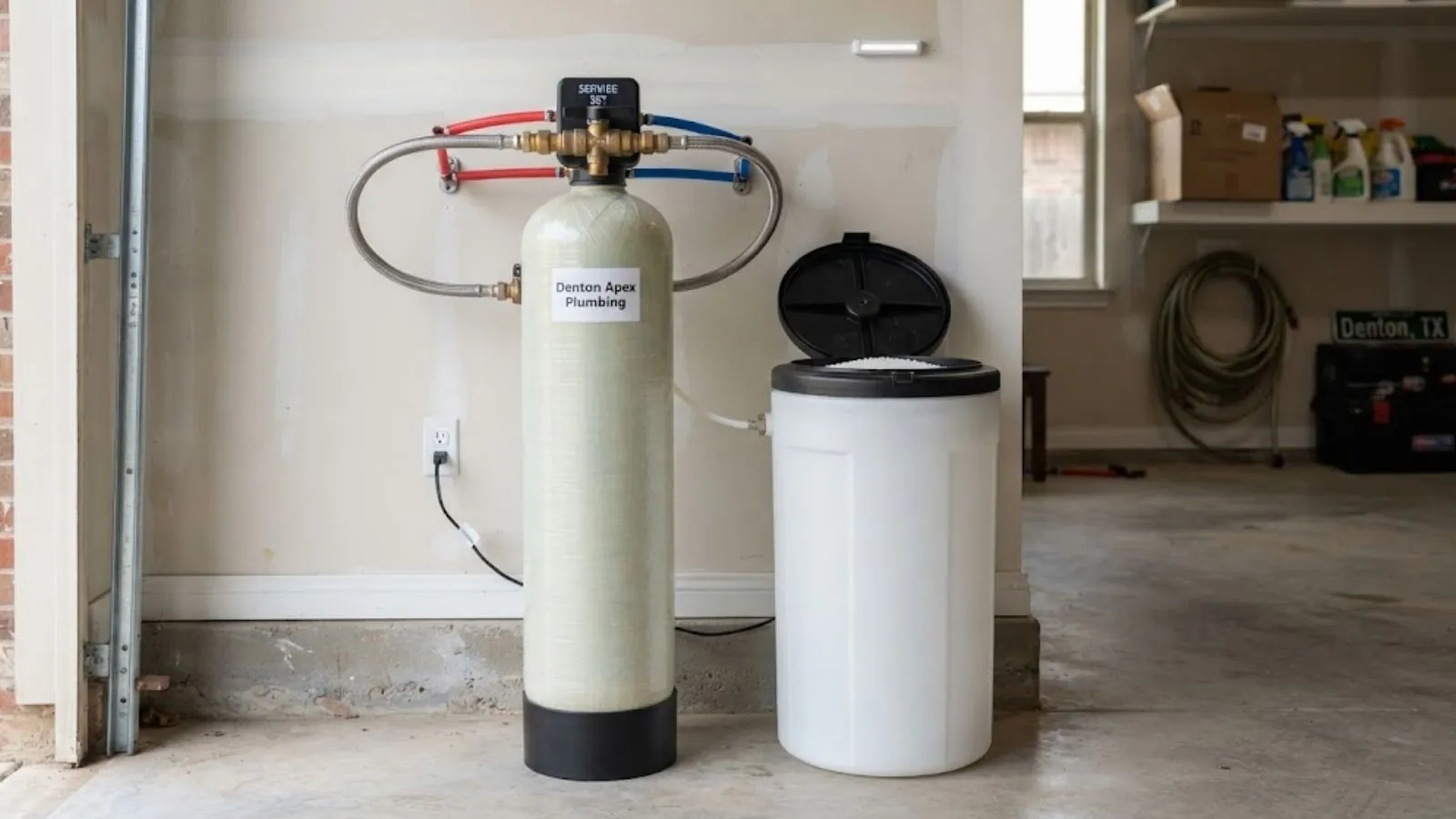
A water softener is a tank of resin beads that swaps calcium and magnesium in the water for sodium or potassium through ion exchange. That stops scale from forming in pipes, fixtures and water heaters.
Published hardness numbers for Denton disagree widely. Some sources call the water moderately hard, others very hard. City water comes from Lewisville Lake and Ray Roberts Lake, and quality shifts with source and season. That is why a test of your own tap comes first.
The Water Quality Association classifies water above about 7 grains per gallon as hard. Below that, a softener may not pay for itself. Above it, the savings on water heaters and fixtures usually justify one.
Softener or filter? They solve different problems
People often buy one expecting it to do the other's job.
| Problem | Softener | Carbon filter or RO |
|---|---|---|
| Scale on fixtures and in heaters. | Yes. | No. |
| Chlorine or chloramine taste. | No. | Yes, with carbon. |
| Spotty dishes and stiff laundry. | Yes. | No. |
| Dissolved solids in drinking water. | No. | Reverse osmosis at the tap. |
If taste or odor is the main complaint, a carbon or RO filter is the better fit.
How a softener is sized and installed
A correct install follows these steps.
- Test the hardness at the tap, in grains per gallon.
- Estimate daily use from the number of people, then multiply by hardness to size the resin tank.
- Pick a location near the main line, with a drain and power, usually in the garage.
- Install a bypass valve, the tank and brine tank, and an air-gapped drain line.
- Set the regeneration schedule and salt level, then test the treated water.
Repairing a softener that stopped working
If the water feels hard again, check the salt first. A salt bridge, a hard crust in the brine tank, can keep the unit from making brine even when the tank looks full.
Other common failures include a stuck control valve, a clogged injector and resin that has worn out after many years. A valve stuck in regeneration can also send water down the drain for hours, which shows up as a high bill. Our guide to finding hidden water losses covers that and more.
Scale that has already built up in a water heater does not disappear when a softener goes in. A flush during water heater repair clears what is already there.
Salt, drains and where the brine goes
A salt-based softener flushes brine down the drain each time it regenerates. The drain line needs an air gap so waste water cannot siphon back into the unit, a detail the 2021 International Plumbing Code (IPC) requires and the inspector checks.
Demand-based control valves regenerate only after a set amount of water has been used, which saves salt and water compared with units on a fixed timer. On a household that travels often, the difference adds up.
Salt-free conditioners are sold as an alternative. They change how minerals form scale rather than removing them, so they do not produce truly soft water. Ask what a product actually does before buying it.
What softener installation and repair cost depend on
These factors move the price.
- Size of the resin tank, based on hardness and household size.
- Type of control valve, time-based or demand-based.
- Loop availability. Some homes have a pre-plumbed softener loop, others need new piping.
- Drain and electrical access at the install spot.
- Repair parts, from injectors to replacement resin.
Softener estimates are free, and the hardness test is part of the visit.
Water softener questions
For most people, yes. A salt-based softener adds a small amount of sodium. People on low-sodium diets can use potassium chloride or drink from a separate unsoftened tap.
It depends on hardness and water use. Many households check monthly and top up when the level drops.
Yes. Scale is the main cause of tankless heat exchanger problems, so softening the incoming water lengthens the time between descaling visits.
Yes, including homes in Corinth and the other nearby towns.
Denton Apex Plumbing coverage map
Coverage map for Denton and the nearby Denton County towns we serve.
Scale everywhere?
Water softener installation and repair across Denton, TX, starting with a hardness test.
Call (940) 229-7314