Water Softener vs Whole-House Filter for Denton Homes
Softeners and filters get sold as if they were interchangeable. They are not. A softener removes hardness minerals, while a filter removes tastes, odors, sediment or specific contaminants. Buying the wrong one is one of the most common water treatment mistakes in North Texas homes, and it is easy to avoid.
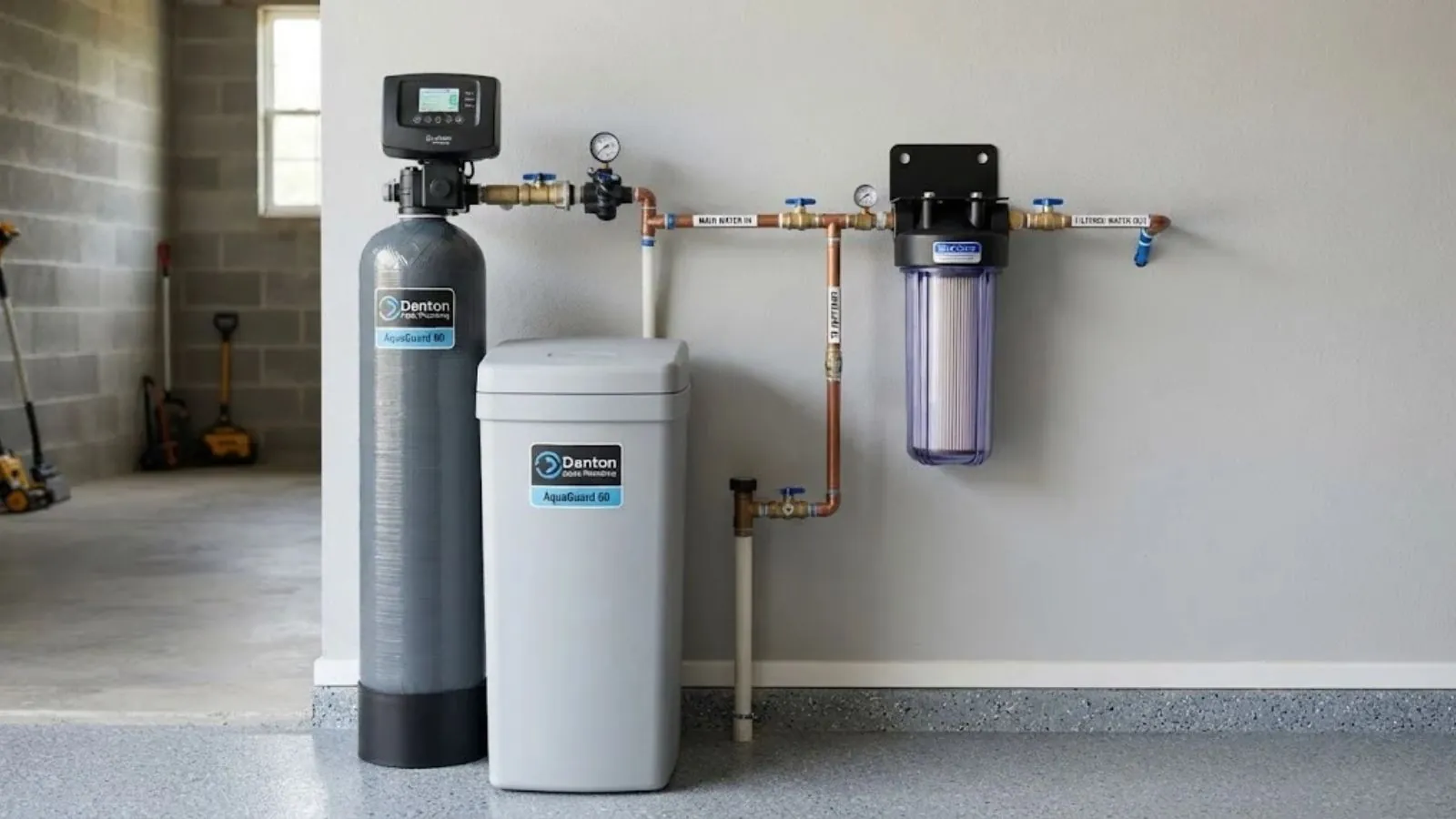
What each one does
A water softener uses resin beads to swap calcium and magnesium, the minerals that make water hard, for sodium or potassium. This process is called ion exchange. The result is water that does not leave scale in pipes, water heaters, faucets and dishwashers.
A water filter traps or absorbs things. Sediment filters catch sand, rust and grit. Carbon filters absorb chlorine and many taste and odor compounds. Reverse osmosis systems push water through a membrane that removes many dissolved solids, usually at one kitchen tap.
A softener does nothing for chlorine taste. A carbon filter does nothing for scale. That is the whole distinction, and it decides what you should buy.
Why Denton hardness numbers disagree
Search for Denton's water hardness and you will find figures that disagree wildly, from moderately hard to very hard. Some of those numbers come from companies selling softeners. Others come from older data or from estimates.
What is certain is the source. The City of Denton draws its water from Lewisville Lake and Ray Roberts Lake and treats it to federal drinking water standards. Surrounding towns vary. Corinth buys treated Lewisville Lake water, Sanger blends city wells with lake water, and Mustang Special Utility District around Aubrey blends aquifer wells with purchased lake water.
Hardness also shifts with season and demand. The only number that matters for sizing equipment is the one at your own faucet.
What to do before you buy anything
Spend a little time here and you avoid buying the wrong system.
- Read your water provider's latest annual water quality report. It lists what the utility tested for and found.
- Test hardness at your tap with a test strip or kit. Test more than once if you are on a blended supply.
- Write down your actual complaint: scale, spotty dishes, taste, smell, sediment or something specific.
- Match the complaint to the table below.
- Get a sizing recommendation based on your test and household size, not a one-size model.
Which one solves your problem
Match what bothers you to the equipment that actually fixes it.
| Problem | Softener | Carbon filter | Sediment filter | Reverse osmosis |
|---|---|---|---|---|
| White scale on fixtures. | Yes. | No. | No. | At one tap only. |
| Water heater scale and noise. | Yes. | No. | No. | No. |
| Chlorine or chloramine taste. | No. | Yes, catalytic for chloramine. | No. | Yes, at one tap. |
| Sand or grit in aerators. | No. | No. | Yes. | No. |
| Dissolved solids in drinking water. | No. | Partly. | No. | Yes. |
When a softener is worth it
The Water Quality Association classifies water above about 7 grains per gallon as hard. Below that, a softener may cost more than it saves. Above it, the savings on water heater life, fixture wear and cleaning products usually justify one.
Softeners protect tankless water heaters especially well, since scale is the main cause of their heat exchanger problems. They also help dishwashers and washing machines last longer.
The trade-offs are real. Softeners need salt, a drain and power. They add a small amount of sodium to the water, which matters for some people on low-sodium diets. Potassium chloride is an alternative, or a separate unsoftened tap for drinking. Our water softener installation page covers sizing and placement.
Sizing a softener: the basic arithmetic
Softeners are rated by how many grains of hardness they can remove between regenerations. A common rule of thumb for daily demand is the number of people in the home, times roughly 75 gallons each per day, times your hardness in grains per gallon.
For example, a household of four at 10 grains per gallon would need about 3,000 grains of capacity per day. A unit sized to regenerate every week or so would need around 21,000 to 24,000 grains of usable capacity, with some margin.
That is why the tap test matters. Plug in a number from a sales brochure instead of your own reading and the unit can end up far too big, wasting salt, or too small, letting hard water through between regenerations. Demand-based valves that regenerate by gallons used, not by the calendar, also help match the unit to real use.
When a filter is the better buy
If the complaint is taste or smell, a filter is the answer. A whole-house carbon filter handles chlorine throughout the home. If your utility uses chloramine as its disinfectant, a catalytic carbon filter handles it better than standard carbon. Your water quality report says which disinfectant is used.
If sediment is the problem, a sediment filter at the main line is inexpensive and protects everything downstream. That matters in areas with well water in the mix, where sand can arrive after a well problem.
For drinking water alone, an under-sink reverse osmosis system is often the most cost-effective choice. Details are in our guide to whole-house and under-sink filters.
Standards and installation details worth knowing
Drinking water filters are commonly certified to NSF/ANSI standards. NSF/ANSI 42 covers aesthetic effects such as chlorine taste, and NSF/ANSI 58 covers reverse osmosis. A product's certification tells you what it has been tested to do.
Installation inside Denton follows the 2021 International Plumbing Code (IPC). Softener and RO drain lines need an air gap so wastewater cannot siphon back into the equipment. A bypass valve lets you shut the system off without shutting off the house.
In towns with sediment events, such as the Aubrey area, a sediment prefilter in front of a softener protects the resin from sand.
Softener and filter questions
Not in the usual sense. They change how minerals form scale rather than removing them. The water still tests hard. Ask what a product actually does before buying it.
Yes. A common order is sediment filter, then softener, then carbon filter, with bypass valves so each can be serviced.
No. Low pressure usually comes from scale-clogged fixtures, a pressure valve or aging pipe. A softener can prevent future scale, but it will not clear existing blockages.
It depends on the filter and your water use. Many sediment and carbon cartridges are changed every few months to a year. Follow the manufacturer's schedule.
Denton Apex Plumbing coverage map
Coverage map for Denton and the nearby Denton County towns we serve.
Need a plumber for this?
Call the 24/7 line for Denton and nearby towns. Describe what you are seeing.
Call (940) 229-7314